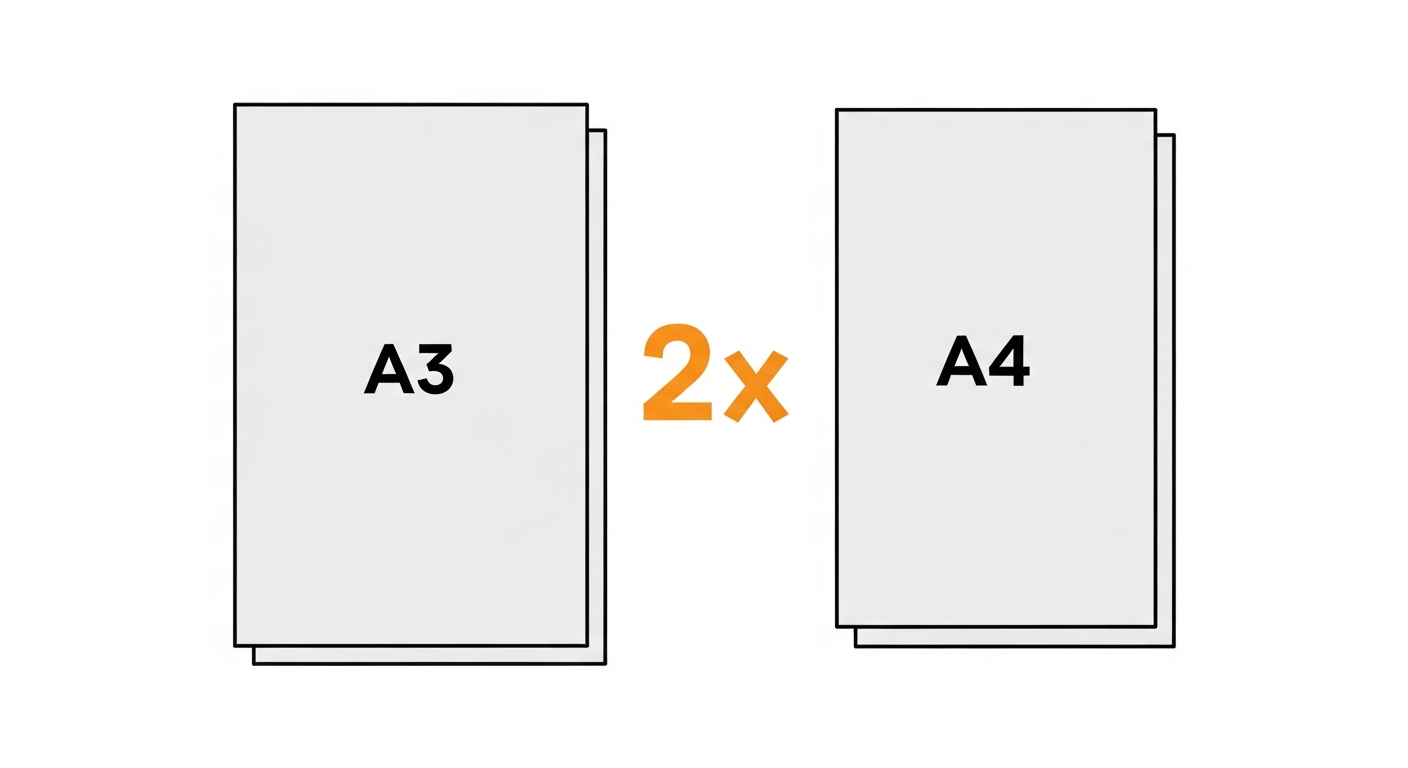
In the Indian printing industry, there's a widely accepted rule of thumb: an A3 print costs twice as much as an A4 print. Service providers use it to calculate AMC charges. Shop owners use it to price jobs. Copier dealers use it to quote cost-per-page figures. But is it actually accurate?
The short answer: for toner cost, it's approximately correct. For total cost, it's an oversimplification that can lead to mispricing. Let's break down why.
The Math Behind the 2x Rule
An A3 sheet measures 297mm × 420mm. An A4 sheet measures 210mm × 297mm. The surface area of A3 is exactly double that of A4 — this is by design in the ISO 216 paper size standard. Every "A" size is exactly half the area of the size above it.
Since toner consumption is roughly proportional to the printed area (assuming similar coverage percentage), an A3 page with the same coverage as an A4 page will use approximately twice the toner. This is where the 2x rule comes from, and for toner, it holds up well.
How Meter Readings Validate the 2x Rule
Most copier manufacturers agree with the 2x principle. That's why many machines count A3 pages differently in their billing counters. On a Ricoh MP 2501, for example, the billing counter increments by 2 for each A3 page printed but only 1 for each A4 page. Konica Minolta bizhub machines do the same in their "Total" counter.
This is also why the standard formula for calculating equivalent A4 pages (sometimes called "A4 equivalent" or "equivalent impressions") is:
Equivalent A4 pages = A4 count + (A3 count × 2)
This formula is used across the industry — by copier dealers, AMC providers, and cost calculators — to normalize page counts to a common unit. It lets you compare machines that print different mixes of A4 and A3.
Real Data from the Field
A print shop in Chennai tracked toner consumption on two identical Ricoh MP 2014AD machines over 3 months. One machine was used primarily for A4 work. The other handled a mix of A4 and A3.
- Machine A (mostly A4): 28,500 A4 pages, 200 A3 pages. Toner consumed: 3 cartridges. Equivalent A4: 28,900. Toner cost per equivalent A4 page: ₹0.34
- Machine B (A4/A3 mix): 14,000 A4 pages, 6,500 A3 pages. Toner consumed: 3 cartridges. Equivalent A4: 27,000. Toner cost per equivalent A4 page: ₹0.37
The toner cost per equivalent A4 page is very similar between the two machines — within 9%. This validates that the 2x conversion is a reasonable approximation for toner. The small difference could be attributed to slightly different coverage patterns between A4 and A3 jobs in this shop.
Where the 2x Rule Holds
The 2x approximation works well for:
- Toner cost: Double the area means approximately double the toner. This is the most significant variable cost, and the 2x rule is reliable here.
- Paper cost: A3 paper costs roughly twice as much as A4 paper (₹4–5 for A3 vs ₹2–2.50 for A4, depending on quality). The 2x rule works for paper too.
- Quick job pricing: When you need a fast estimate for a customer, applying 2x to your A4 rate for A3 jobs is a reasonable ballpark.
Where the 2x Rule Breaks Down
The 2x rule starts to fail when you look beyond toner and paper:
1. Machine Wear Is Not Exactly 2x
When the machine processes an A3 sheet, the paper travels through the entire paper path — feed rollers, transfer belt, fuser — once, just like an A4 sheet. The sheet is longer, so it spends more time in the fuser and puts slightly more wear on transport rollers. But it's not a clean 2x impact on mechanical components.
A fuser rated at 100,000 pages doesn't care whether those pages are A4 or A3 — it cares about the number of sheets that pass through it and the total heat cycles. In this sense, an A3 page causes perhaps 1.2–1.5x the fuser wear of an A4 page, not 2x.
2. Drum Wear Is Closer to 1.4x
The drum rotates a fixed number of times per page, regardless of paper width (A3 and A4 are the same width when fed long-edge first, which is standard). The drum rotates more for the longer A3 sheet, but the extra rotation is about 40% more, not 100% more. So drum wear per A3 page is roughly 1.4x that of an A4 page.
3. Service Costs Don't Scale by Paper Size
Your service engineer charges per visit or per month, not per square millimeter of paper processed. If your machine prints 5,000 A4 pages and 2,000 A3 pages in a month, the service cost is the same as if it had printed 9,000 A4 pages. The 2x rule doesn't apply to service charges at all.
4. Electricity and Time
An A3 page takes slightly longer to print than A4, but the machine's power consumption per page doesn't double. The laser scans across the same width; only the paper travel length increases. For shops that factor in electricity cost, A3 is perhaps 1.3x, not 2x.
The Practical Formula
Given all of this, here's a more nuanced way to think about A3 costing:
- Toner cost per A3 page: A4 toner cost × 2 (the 2x rule works here)
- Paper cost per A3 page: A4 paper cost × 2 (roughly accurate)
- Parts cost per A3 page: A4 parts cost × 1.3–1.5 (mechanical wear doesn't double)
- Service cost per A3 page: Same as A4 (service is per visit, not per page size)
For a typical machine where toner is 40% of total cost, paper is 30%, parts are 20%, and service is 10%:
- A4 total cost: ₹1.00 (example)
- A3 total cost: (0.40 × 2) + (0.30 × 2) + (0.20 × 1.4) + (0.10 × 1.0) = 0.80 + 0.60 + 0.28 + 0.10 = ₹1.78
So the real multiplier is closer to 1.78x, not 2x. The 2x rule overestimates A3 cost by about 12%. This might seem like a small difference, but for a shop printing 3,000 A3 pages a month, that's a pricing error of ₹660 per month or nearly ₹8,000 per year.
Why the Industry Sticks with 2x
Despite the mathematical imprecision, the 2x rule persists for good reasons:
- Simplicity: It's easy to communicate and calculate. Telling a customer "A3 is double" is cleaner than "A3 is 1.78x."
- Safety margin: Overestimating by 12% gives you a buffer against unexpected costs. In the printing business, unexpected costs are the norm.
- Industry standard: AMC providers, dealers, and billing systems all use the 2x conversion. Deviating from it creates confusion in a market that's already complicated enough.
- Toner dominance: In many shops, toner is the single largest cost component, and for toner, 2x is accurate. The areas where 2x fails are smaller cost components.
The Bottom Line
Use the 2x rule for your day-to-day operations. It's close enough to be practical and is the industry standard everyone understands. The formula Equivalent A4 = A4 + (A3 × 2) is the right way to normalize your page counts for cost calculation.
But know that the 2x rule slightly overstates total A3 cost. If you're in a competitive market where pricing margins are thin — especially for high-volume A3 jobs like architectural drawings, posters, or large-format scanning — you might gain an edge by pricing A3 at 1.8x instead of 2x. You'll still be profitable, and you'll be more competitive.
The key is to track your actual costs with meter readings. When you know your real toner cost, parts cost, and service cost per equivalent A4 page, you can make pricing decisions based on data rather than rules of thumb.
The 2x rule is a good approximation. But your meter readings are the truth. Use the rule for simplicity; use the data for accuracy.
PrintCostCalculator tracks A4 and A3 meter readings separately and automatically converts to equivalent A4 pages using the standard formula. See your actual cost per page across all paper sizes, and price your jobs with confidence. Try it free for 30 days.